
Rooted in Partnerships
1991
Legally incorporated in 1991, Jeffery Hale Community Partners began as the Holland Resources Development Corporation (HRDC). At the heart of what was then known as Holland Centre, the corporation was established through a formal agreement of five partners from the community and public sector.
2008
Always adapting and expanding to meet the needs of the community, the Holland Centre offered a wide range of community health and social services to the English-speaking population of the Greater Québec City region. In 2008, HRDC changed its name to become Jeffery Hale Community Partners (JH Partners). This gesture served to publicly demonstrate and solidify our close ties to Jeffery Hale – Saint Brigid’s.
2015
A little later, in 2015, the Holland Centre, located in the Jeffery Hale Pavilion, was rebranded to become the community Jeffery Hale, or simply the WE! Despite the name changes, there has been one constant in our story from the start: Growing health and social services and resources for the community through collaboration, knowledge, and capacity-building.
Innovations & Initiatives
Over the years, several innovative and lasting initiatives have emerged since JH Partners came into existence, such as:
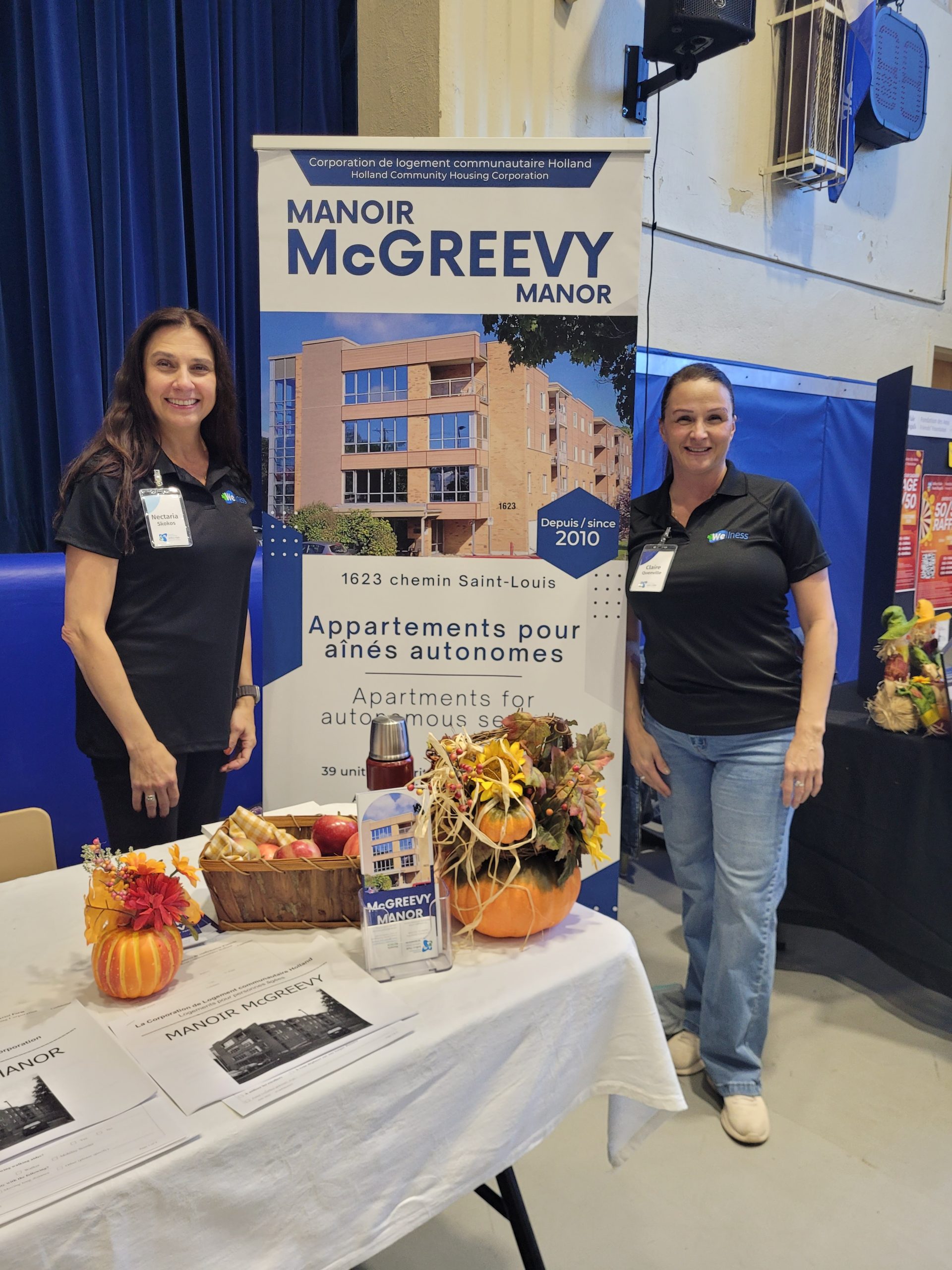
McGreevy Manor, an adapted living residence for autonomous seniors.
SNACS, an innovative community based program to support young adults with special needs.
A longstanding and dynamic early childhood and parent support program.
Solid and structured volunteer support services.
The early community development and service model initiatives led by our dynamic Québec City partnership paved the way, we are proud to say, for many other similar initiatives across the province. These initiatives were also, in fact, at the heart of the approach adopted over 20 years ago by the founders of the highly successful Community Health and Social Services Network (CHSSN). JH Partners remains very active as supporters, collaborators and members in the countless initiatives and collaborative networks funded and nurtured by CHSSN throughout Québec today.
Today
See a full list of our core members, valued funders and key collaborators on our Community of Care page. Learn more about all of our current areas of strategic focus and the activities that come under each.


A Community of Care
“Collaborative partnerships are agreements and actions made by consenting organizations… to accomplish a mutual goal… (They) rely on participation by at least two parties who agree to share resources, such as finances, knowledge, and people.”
“The essence of collaborative partnership is for all parties to mutually benefit from working together. There are instances where collaborative partnerships develop between those in different fields to supplement one another’s expertise. The relationships between collaborative partners can lead to long term partnerships that rely on one another.”
Why a Community of Care?
Common objectives build capacity
Tapping into deep-rooted collective strength, we work in partnership to build common capacity and resources to support the increasingly diverse English-speaking minority and the more vulnerable members of this community, and respond to their evolving health and social needs.
Our partnership exists to reciprocally capitalize on the strengths and opportunities of one distinct public sector institution, with its special mission to serve our minority community, along with those of the grassroots community organizations within this same community.
Without ever being an entity unto itself, the Community of Care sets its own jointly-agreed-upon and mutually beneficial goals for the wellbeing of the community. It does not answer to, nor aspire to, the goals of any one particular partner. Its successes, however, may include projects or accomplishments that are of exceptional value to one or another of the partners, or contribute to their singular accountability requirements.
The effectiveness of the partnership between these grassroots organizations and its public sector service provider is of great importance to our community. Otherwise, our relatively modest minority community would have limited means to influence decision makers and ensure adequate response to its health and social services needs.
Who is involved?
- Jeffery Hale Community Partners (JH Partners), a community-based charitable organization with health and well-being mission.
- Jeffery Hale – Saint Brigid’s (JHSB), a public sector institution with historic roots in the community.
- Other community organizations sharing a mission to support the community, especially Voice of English-speaking Québec (VEQ).
A bit of history
What we now refer to as the Community of Care has evolved over the last 30 years. Before then, there existed a collection of various institutions and organizations which had emerged from within the English-speaking community over the span of about 150 years. Thanks to each of their historic influences and resources along with the engagement of their relatively large (by today’s standards) memberships, this loose band of organizations managed to provide a range of services―albeit uneven and incomplete―to the sick and needy.
In the early 1970’s, the government had put a comprehensive public system in place that oversaw both the Jeffery Hale Hospital and Saint Brigid’s Home. At that time, the community organized its volunteer and charitable support primarily around these institutions, often along religious lines. By the late eighties, however, it became apparent that
the English-speaking community had been left out of the more comprehensive community-based CLSC network introduced across the province as part of the reforms to the public health and social services system during that decade.
Enter the Holland Centre at the very start of the 90’s, an emergent collaborative effort between the community and its historic public institutions. The Centre was the initial focal point for the first-ever truly comprehensive joint community effort to build its capacity to support people in need of all ages, and across religious and historical affiliations. The partnership has evolved since then, due both to the passing of time and to expanding resources and changing conditions, notably in terms of the organization and governance of the health system.
In the early 2000’s, a more integrated partnership model emerged that blurred the lines between the public and community sectors. The goal here was to simplify access and encourage further collaborative development of services. This shift was made possible due to prevailing governance structures that favoured the community’s direct involvement in decision making, which also encouraged the community to substantially invest its financial and volunteer resources in service development and provision.
Why a formal partnership?
In 2015, the government introduced the CIUSSS network, which saw our region’s CIUSSS take control of Jeffery Hale – Saint Brigid’s, although that establishment remained a separate legal entity. This change in governance had an enormous impact on our community’s influence on JHSB and how it was managed. Over time, through considerable effort and resources, the community has recovered its place in JHSB’s priorities. The new context, however, required a renewal of joint structures and processes. Adapted to the governance conditions of recent times, the Community of Care of 2019 was an important cornerstone that poised us to move into the future. We are now in a good position in our efforts to jointly build capacity and better serve the English-speaking community and its evolving needs.
The formal mechanisms required to work together have been agreed upon, and make this partnership function smoothly and effectively. All the members and stakeholders of this collaborative initiative, including JH Partners, have agreed to invest the significant efforts required to define and maintain general conventions, participation structures, joint processes, and shared responsibilities, as well as to determine common objectives and priorities.
Our Community of Care Committee
Our joint committee meets regularly to maintain momentum and agree to future common objectives and priorities. Its is composed of key professionals and managers of the member organisations.
The committee’s work is centred on two principal objectives aimed at concerted action in support of better health and social services for the English-speaking population:
- Ensure the community’s ongoing development and build its capacity by working to:
- ⤷ Valourize community assets
- ⤷ Inform and mobilize
- ⤷ Influence decision-makers
- Support vulnerable individuals through responsive and efficient wellness and healthy living services
- ⤷ Respond to individual and collective service needs
- ⤷ Mobilize community volunteers
- ⤷ Coordinate inter-organizational service provision
Guiding Principles
When setting up our Community of Care Committee, we jointly took the following elements into consideration:
The basics
- Accountability/mandate/legitimacy.
- Partner/stakeholder engagement.
- Agreement: JHSB, JH Partners, VEQ.
- Roles and responsibilities.
- How formal? Membership, facilitation, structure, tools, records.
- Visibility and image.
- Who is involved (stakeholders)? What contribution is expected?
Making this work
- Joint definition of conditions for success.
- Consultative mechanisms/external input.
- Shared vision/exterior (altruistic) focus.
- Joint analysis of issues SOAR (strengths, opportunities, aspirations, results).
- External allies/network.
General conventions regarding participation
- Common understanding that our work is COMPLEX and UNPREDICTABLE.
- Trust across and within.
- Curiosity for other people and other way to achieve things.
- Shared information/resources.
- Consensual decision making.
- Shared values.
- Celebrating success! Shared/individual credit.
- Permeable borders.
Recommendations inspired by recognized experts
- Encourage authentic communication and shared information at all levels within the partnership and inside each partner organization (as well as discretion and respect of privacy): Nurture forms of communications that are open, honest, nonjudgmental, and non-evaluative; attack the issues, not people.
- Listen intently: Hear the concerns, comments and suggestions of others and take it into account in the pursuit of the common goal and for future adjustments (it allows for real interdependence and greater trust between people)
- Speak up: Communicating honestly and directly with others by asking questions, acknowledging errors, raising issues, and explaining ideas.
- Experiment: Taking an iterative approach to action that recognizes the novelty and uncertainty inherent in interactions between individuals and in the possibilities and plans they develop.
- Conflict: Fostering a safe and creative space that encourages divergent (dissent) thinking
- Acknowledge both individuality and interdependence: Recognizing the interrelated relationships of members of a group with each other and interrelated relationships between groups and organizations
- Commitment and full participation: Searching for new ideas, propositions or other elements because it will contribute to more innovation and thereby to achievement of the common goal.
- Acknowledge collective intelligence: Understanding a group or a team’s combined capacity and capability to perform a wide variety of tasks and solve diverse problems.
Maintain an atmosphere conducive to learning and development: Encouraging an open mindset and the desire to invest in partners’ skills and knowledge will create mutually rewarding opportunities to shape each other’s work and learn together. In this environment, members can reflect honestly on both successes and failures and give and receive support.
Our far-reaching Community of Care!
Core Members
- Church Society of the Diocese of Quebec
- Citadel Foundation
- Congregation of the Catholics of Quebec Speaking the English Language
- Jeffery Hale – Saint Brigid’s Corporation
- Jeffery Hale Foundation
- Saint Brigid’s Home Foundation
Valued Funders
- CHSSN, especially their Networking and Partnership Initiative (NPI)
- Health Canada
- Jeffery Hale – Saint Brigid’s Friends’ Foundation
- Jeffery Hale – Saint Brigid’s (grouped with the CIUSSS de la Capitale-Nationale)
- L’APPUI de la Capitale-Nationale pour les proches aidants d’aînés
- McGill University
- Ministère de la Famille
- Saint Brigid’s Guild
- Secrétariat aux relations avec les Québécois d’expression anglaise
Key Collaborators
Knowledge Sharing
- Centre of Expertise ACESS (Adaptation for English-speaking Communities in Health and Social Services)
- Concordia University
- Équipe de recherche en partenariat sur la diversité culturelle et l’immigration dans la région de Québec (ÉDIQ)
- Table régionale de concertation en immigration de la Capitale-Nationale